Buying land is one of the most significant investments you can make, but also one of the most complex from a tax perspective. One of the most frequent doubts we receive in our office is determining which tax applies to the operation: Should you pay Value Added Tax (VAT) at 21% or Property Transfer Tax (ITP) at 7%?
The answer is not unique and fundamentally depends on two factors: the urban condition of the land and the nature of the seller. Below, we break down the keys to understanding the taxation of urbanized land in Spain.
The nature of the land: Rustic or Urban?
In the tax field, the distinction between “bare” land and “urbanized” land is vital. As a general rule, the sale of rustic or non-buildable land is exempt from VAT, therefore being taxed by ITP (whose management is transferred to the Autonomous Communities, 7% in Andalusia).
However, the situation changes drastically when we talk about buildable or urbanized land. As discussed in the general real estate field, for land to be considered “urbanized” for tax purposes, it must have a series of services and infrastructures. Conceptually, this implies that the land has road access, water supply, sewage disposal, and electricity supply. In Spain, this legal condition is what transforms simple land into a “plot” (solar) suitable for building.
The seller’s status: Business professional or Private individual?
This is the critical point that determines the application of the tax. For an operation involving the sale of urbanized land to be subject to VAT, the seller must be a business professional or entrepreneur acting in the exercise of their activity.
There is common confusion about when a seller is considered “habitual”. In the sector, it is usually understood that habitual sellers are those who buy with the intention of reselling or real estate developers. In Spanish legislation:
- Private Seller: If the person selling the urbanized land is a private individual who does not act as a business professional, the operation will be subject to ITP, never to VAT.
- Business/Developer Seller: If the seller is a company or developer and the land is buildable (plot), the operation carries VAT at 21%.
What is considered “Urbanization” for tax purposes?
Disputes often arise about whether land is truly urbanized. It is not enough for certain elements to exist nearby; the law requires the urbanization to be effective. As mentioned in debates on the matter, the mere existence of “gravel” or precarious access does not necessarily constitute urbanization.
For VAT to accrue, the land must have the condition of a plot or be in the urbanization phase initiated by the developer. If it is raw land where there are only urban expectations but no approved infrastructures (water, electricity, sewage inside the plot and not just “passing nearby”), the Tax Agency could consider it rustic for tax purposes, remaining exempt from VAT.
Buying land believing it is urban (paying VAT) when in reality it does not have the proper urban classification can lead to future problems, not only tax-related but also regarding building permits.
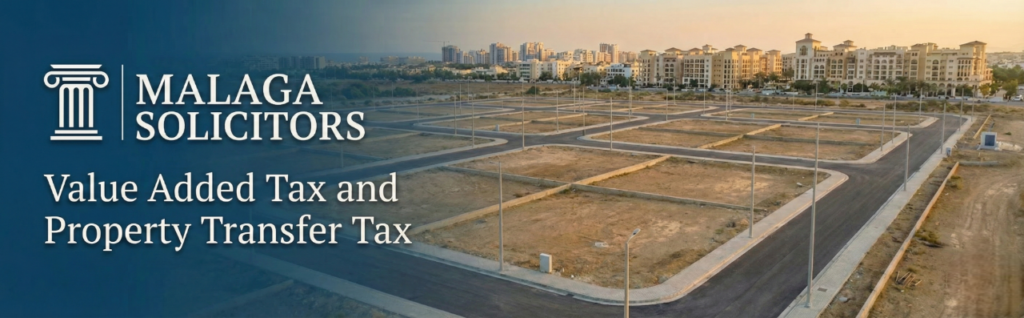
Differences in tax rates in Spain
It is crucial to calculate costs well before signing. The economic difference is notable:
- VAT: Generally 21% for plots and buildable land.
- ITP: In Andalusia, it is currently a reduced rate of 7% (generally), which represents considerable savings compared to VAT.
Incorrectly determining the tax can lead to penalties from the Tax Authority or paying an unnecessary extra cost.
Specialized legal advice
The line separating rustic land from land undergoing urbanization or a finalized plot is often thin and technical. An error in classification can mean a 14% difference in the final cost of the operation (the difference between 7% ITP and 21% VAT).
At Malaga Solicitors, we review the real urban situation of the plot at the Town Hall and verify the tax status of the seller to ensure you pay the correct tax, not a euro more.
If you are thinking of buying or selling land and have doubts about its taxation, do not take risks.
Contact us:

Author: Clara Cuevas Rodríguez
Marketing Department – Malaga Solicitors Group
Responsible of updating the website, network planning, customer follow-up and data monitoring.
Languages: Spanish and English.




 English
  Dutch
Dutch