
Málaga province has been a crossroads of civilisations for more than two thousand years. Phoenicians, Romans, Visigoths and Moors all left their mark, and nowhere is this more visible than in the province’s extraordinary collection of castles and fortresses.
But history alone does not explain why Málaga has become one of the most popular destinations for foreigners living in Spain. In 2026, Spain is home to approximately 9.5 million foreign residents, and Málaga province consistently ranks among the top three destinations for international buyers and settlers. This guide explores both sides of the story: ten castles worth visiting in the province, and what makes this part of Spain so compelling for people from abroad.
Why So Many Foreigners Choose to Live in Málaga
The reasons are not hard to find. More than 300 days of sunshine per year. A reformed city centre with world-class museums (the Pompidou, the Russian Museum and the Carmen Thyssen all have outposts here). A fast-growing tech and creative sector. Some of the best-value coastal property in southern Europe. Direct flights to London, Dublin, Amsterdam, Frankfurt and a dozen other European cities. And a legal and administrative infrastructure that has become increasingly accustomed to handling the needs of non-Spanish residents.
According to Spain’s National Statistics Institute (INE), the number of foreign-born residents in Spain grew by more than 4% between 2023 and 2025. British nationals remain among the largest groups, with around 300,000 registered across the country, many of them in Andalucía.
The 10 Castles of Málaga Province
1. Alcazaba de Málaga
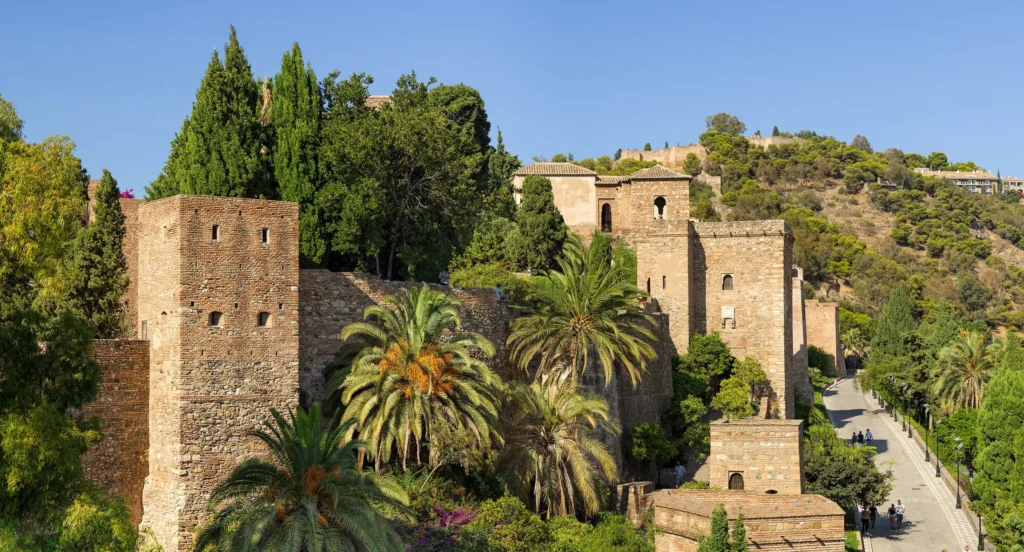
The most visited of all, the Alcazaba sits above the city of Málaga and dates from the eleventh century, built on the ruins of a Roman theatre. Its tiered gardens, ornate archways and views over the port make it one of the best-preserved Moorish palaces in Spain. It is connected by a rampart walkway to Gibralfaro Castle above it.
2. Castillo de Gibralfaro
Perched on the hill above the Alcazaba, Gibralfaro was built in the fourteenth century by Yusuf I of Granada to house his troops and protect the Alcazaba below. It offers panoramic views over the entire city and the bay. The walk up through pine-scented paths is worth it in its own right.
3. Castillo de Cártama
One of the lesser-known gems of the province, the castle of Cártama sits on a hill above the town of the same name, about 20 kilometres west of Málaga. The ruins date from the Moorish period and offer views over the Guadalhorce valley. Cártama itself is one of the more affordable towns for property buyers looking for easy access to Málaga city.
4. Castillo de Fuengirola (Sohail)
The Sohail Castle overlooks Fuengirola from a low hill at the western end of the beach. Originally a Phoenician watchtower, it was rebuilt by the Moors and later modified by the Christians. Today it hosts an annual summer music festival and offers good views of the coast.
5. Castillo de Monda
The white village of Monda, in the hills behind Marbella, is dominated by its castle, which has been converted into a hotel. The original fortress dates from the Moorish period and was later occupied by the Nasrid kings. The views over the surrounding countryside are spectacular.
6. Castillo de Casares
Casares is regularly cited as one of the most beautiful white villages in Andalucía. Its castle sits at the very top of the village, with the houses of the town clinging to the hillside below it. The surrounding countryside takes in the Genal Valley and, on a clear day, the Rock of Gibraltar.
7. Torre del Mar and the Watchtowers of Axarquía
The eastern Costa del Sol is dotted with Moorish watchtowers (atalayas) that once formed a chain of communications along the coast. Many are now in ruin, but several have been restored and can be visited on the coastal footpath between Torre del Mar and Nerja.
8. Castillo de Vélez-Málaga
Rising above the capital of the Axarquía comarca, the castle of Vélez-Málaga was one of the last strongholds to fall to the Catholic Monarchs in 1487. The ruins have been partly restored and the site hosts cultural events during the summer months.
9. Castillo de Manilva
The small coastal town of Manilva, at the western tip of the Costa del Sol, has a ruined tower that formed part of the town’s medieval defences. It is modest compared to the larger castles further inland, but it sits in a wine-producing area and the surrounding countryside, with its vineyards and clifftop coastal views, is worth a long afternoon.
Living in Málaga as a Foreigner: What You Need to Know
Whether you are buying a holiday home, retiring permanently or relocating with your family, the practical and legal landscape for foreigners in Spain has changed considerably since Brexit. EU citizens retain freedom of movement but still need to register and obtain residency documentation after three months. British and other non-EU nationals need to apply for a visa before arriving.
The most common issues that international residents encounter include: obtaining the NIE number (required for almost every official transaction), understanding non-resident property tax obligations, navigating the Spanish inheritance and succession rules, and making sure their wills are valid under both Spanish and home-country law.
Frequently Asked Questions
Do I need a visa to buy property in Málaga as a British national?
No. Buying property does not require a visa. However, if you plan to live in Spain for more than 90 days in any 180-day period, you will need a residency visa. The most common option for retirees is the Non-Lucrative Visa, which requires proof of sufficient passive income or savings. Your lawyer can advise on which visa best fits your situation.
Is Málaga a good place to retire?
Consistently, yes. The combination of climate, healthcare quality (Spain has one of the best public healthcare systems in the EU), cost of living, cultural richness and accessibility from the UK and northern Europe makes Málaga one of the most popular retirement destinations in the world. The province has well-established expat communities in Marbella, Mijas, Nerja, Fuengirola and Manilva.
What is the cost of living in Málaga compared to the UK?
Broadly speaking, day-to-day living costs (food, restaurants, transport, utilities) are 20 to 30% lower in Málaga than in comparable British towns and cities. Property prices vary enormously by location, but it is still possible to buy a well-located apartment on the Costa del Sol for under €200,000. Private healthcare in Spain is also significantly cheaper than equivalent private provision in the UK.
Can I bring my UK pension to Spain?
Yes. UK state pensions and most private pensions can be paid into a Spanish bank account. However, you will need to declare your pension income to the Agencia Tributaria as part of your annual Spanish tax return if you are a Spanish tax resident. The UK-Spain double taxation treaty prevents you from being taxed on the same income in both countries, but the interaction between the two systems requires careful management.
Planning to Buy or Settle in Málaga Province?
Moving to Spain is an exciting decision, but it also comes with important legal and administrative steps. Málaga Solicitors has assisted many clients who have relocated to Spain, including both EU citizens and non-EU nationals, helping them with property purchases, NIE applications, residency procedures, tax matters, wills and inheritance planning.
With more than 37,500 property transactions completed over the past 25 years, our lawyers understand the specific needs of international buyers and foreign residents moving to Málaga, the Costa del Sol and Andalucía.
Whether you are buying a holiday home, retiring in Spain or relocating permanently with your family, our English-speaking team can guide you through the process with clear, practical legal advice.
Email: mail@malagasolicitors.com
Tel: (+34) 952 021 225
WhatsApp: (+34) 646 776 118
Fill in the contact form below and our team will get back to you with clear, practical advice. No obligation, no legal jargon.

Marketing Department – Malaga Solicitors Group
Responsible of updating the website, network planning, customer follow-up and data monitoring.
Languages: Spanish and English.




 English
  Dutch
Dutch