

Buying an off-plan property in Spain can be an exciting prospect. You may be choosing a brand-new home in the Costa del Sol, considering an apartment as an investment, or simply looking at a development that will not be completed for another year or two. Whatever your reasons, there is one obvious concern: how safe is it to pay for a property that does not yet exist in its finished form?
In this guide, we explain how off-plan property purchases work in Spain, the main advantages and risks, the legal checks that should be carried out and the protections that may apply to payments made during construction. Most importantly, we will look at the questions you should be asking before you sign a contract or transfer your money.
Please note: This article provides general information about buying off-plan property in Spain. The legal position can depend on the development, contract, location and circumstances of the individual transaction. Specific legal advice should therefore be obtained before making a purchase.
What does buying off-plan property in Spain actually mean?
Buying buiten plan means agreeing to purchase a property before construction has been completed. Depending on when you enter the development, you could be buying when construction is already well underway or at a much earlier stage when your decision is based largely on plans, specifications, computer-generated images and information provided by the developer.
That creates an obvious difference compared with buying a resale property.
When you buy an existing home, you can walk through the rooms, inspect the building and see reasonably clearly what you are purchasing. With an off-plan property, part of your decision concerns something that is still to be built.
This does not make off-plan property inherently unsafe. It does, however, mean that the legal documentation and due diligence become particularly important.
Why do people buy properties off-plan?
There are several reasons buyers are attracted to new developments.
A newly built home may offer modern specifications, better energy efficiency and fewer immediate maintenance requirements than an older property. Depending on the developer and the stage of construction, buyers may also have some choice over finishes, fixtures or other details.
De payment structure can also be different. Instead of paying the entire purchase price at once, an off-plan contract may provide for payments at different stages before completion.
Some buyers are also attracted by the possibility that the market value of a property could change between reservation and completion. However, this should never be treated as a guaranteed return. Property prices can rise or fall, and an off-plan purchase should be assessed on its actual merits rather than on an assumption of future capital appreciation.
So, is it safe to buy an off-plan property in Spain?
Buying off-plan in Spain can be a safe way to purchase property, but the safety of an individual transaction depends heavily on the development, the developer, the contract and the legal checks carried out before the buyer commits their money.
Spanish law provides important protections in relation to certain advance payments made towards properties under construction. However, the existence of legal protections does not remove the need for proper due diligence.
Before purchasing, a buyer should understand who owns the land, who the developer is, whether the appropriate planning and building documentation is in place, how advance payments will be handled, what guarantees apply and what the contract says about completion, delays, changes and default.
This is where there is an important distinction between finding an attractive development and establishing that it is a legally sound purchase.
A beautiful development is not the same as a safe transaction
It is very easy to become emotionally invested in a new development.
You see the location. You choose the apartment. You imagine the terrace, the pool and your mornings in the Spanish sunshine. The sales material looks impressive and suddenly the reservation form feels like a small administrative step between you and your future home.
Legally, however, this is precisely the point at which you should slow things down.
Marketing materials tell you why you might want the property. Legal due diligence tells you whether you should proceed with the transaction on the terms being offered.
Those are two very different jobs.
The estate agent or developer’s sales team is involved in selling the property. Your independent lawyer’s role is to examine the transaction from your side and identify issues that could affect your interests.
That distinction becomes particularly valuable when you are buying in another country and may not be familiar with Spanish property law, contractual terminology or the administrative procedures surrounding new developments.
Why independent legal advice matters
A property lawyer can examine the documentation behind the development rather than relying solely on what appears in a brochure or reservation document.
This can include reviewing the legal ownership and charges affecting the property or development, checking relevant planning matters, reviewing contracts, examining the arrangements surrounding advance payments and explaining the obligations you are accepting.
If you would like a broader overview of our role throughout a Spanish property transaction, read our guide to legal advice when buying property in Spain.
The ideal time to carry out these checks is before you become contractually committed, not after a problem has appeared.
What should a lawyer check before you buy off-plan in Spain?
The precise checks required will depend on the property and development. There is no useful one-size-fits-all checklist that can replace reviewing the actual transaction.
Nevertheless, several areas deserve particular attention in an off-plan purchase.
Who owns the land and who is developing it?
Before looking at the apartment itself, it is necessary to understand the legal position behind the development.
- Checks can be made through the Spanish Land Registry to establish the registered ownership of the relevant land and identify mortgages, charges or other registered matters that could affect it.
- The developer should also be properly identified. Buyers should know exactly which legal entity they are contracting with rather than relying simply on the commercial name of a development.
- The Consejo General del Notariado also recommends that buyers of off-plan homes establish who owns the land and obtain information about the developer and its financial position before proceeding.
These details may sound less exciting than choosing the kitchen tiles, but they are considerably more important if something goes wrong.
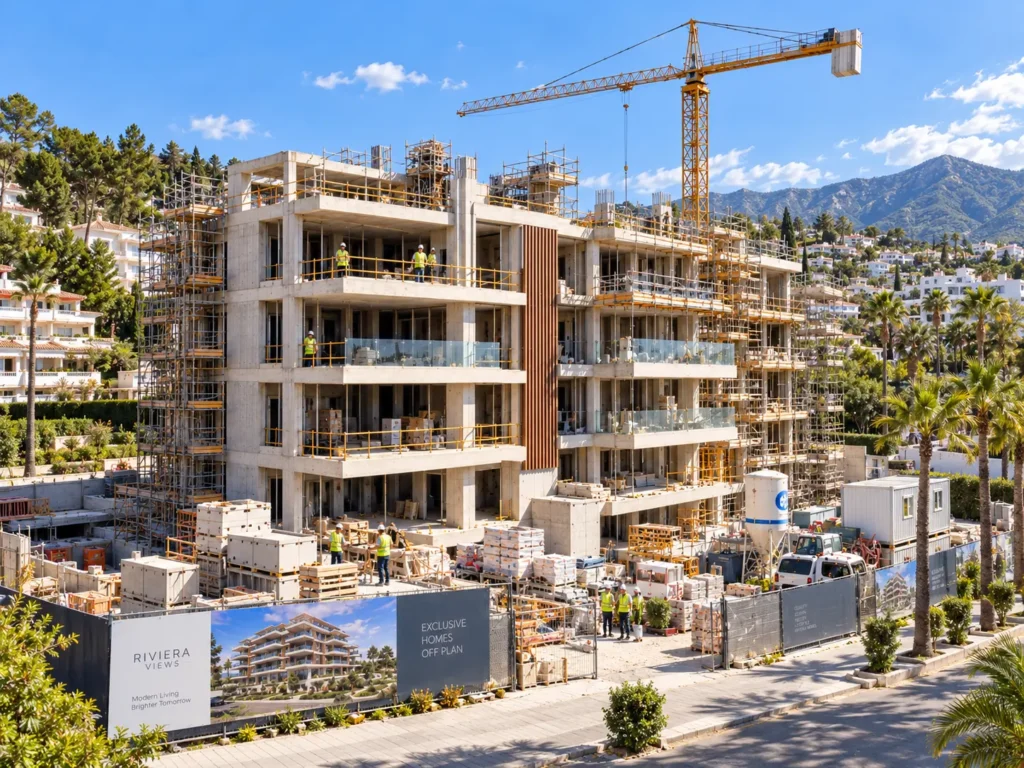
Does the development have the appropriate planning and building position?
De legal and planning position of the development should also be reviewed.
A lawyer can examine the relevant documentation and determine what needs to be verified for that particular development and municipality. This matters because buying a property shown in marketing material is not the same as confirming that the development has the appropriate legal basis to be built and ultimately occupied.
The documentation surrounding first occupation is another relevant consideration when the development reaches completion. The precise mechanism can vary according to the applicable regional planning legislation, so buyers should not assume that the terminology or procedure will be identical everywhere in Spain.
Be careful with the reservation agreement
The reservation stage can feel informal because the amount involved is normally much smaller than the full purchase price. But “smaller” does not mean unimportant.
Before signing a reservation document and transferring money, you should understand exactly what you are agreeing to. In particular, the document should be reviewed to establish the circumstances in which the reservation money can be returned or retained and what happens if the transaction does not proceed.
This becomes especially important if your purchase depends on something that has not yet happened, such as obtaining finance.
Do not assume that a reservation deposit will automatically be refundable simply because you change your mind or your circumstances change. The answer depends on the agreement and the facts of the case.
The safest approach is simple: have the reservation terms reviewed before signing and paying, rather than trying to negotiate your way out of them afterwards.
The private purchase contract deserves even more attention
The private purchase contract is a key document in an off-plan transaction because it establishes the obligations that will govern the purchase during the construction period.
Among other matters, it may deal with the purchase price, payment schedule, characteristics of the property, anticipated completion arrangements, consequences of delay, contractual default and other rights and obligations of the parties.
This is not the place for a quick signature because somebody says the document is “standard”. A standard contract can still contain provisions with significant consequences for the individual buyer. Your lawyer should review the actual wording and explain the parts that matter to you before you commit yourself. Neem contact met ons op.
How are off-plan payments protected in Spain?
This is one of the most important areas to understand when considering an off-plan property.
Under Spain’s Ley 38/1999, de Ordenación de la Edificación, developers receiving advance payments towards the construction of homes are subject to specific requirements.
From the granting of the building licence, the legislation requires the developer to guarantee the return of qualifying advance amounts, together with the applicable legal interest, through a qualifying insurance arrangement or joint and several bank guarantee if construction does not begin or the property is not completed within the agreed period.
The law also requires advance payments to be received through a credit institution and deposited in a special account separate from the developer’s other funds, with those funds used for purposes connected with construction.
Importantly, the statutory guarantee extends to qualifying amounts paid in advance, including applicable taxes, together with legal interest.
Do you receive an individual guarantee?
The legislation goes further than simply requiring the developer to say that payments are “guaranteed”.
Where advance payments are agreed in the relevant purchase contract, the documentation should identify the insurance or bank guarantee arrangement and the institution involved. The law also provides for the purchaser to receive documentation evidencing the guarantee in relation to the advance amounts.
This is exactly why buyers should not be satisfied with vague assurances such as “don’t worry, the development is guaranteed”.
Your lawyer can examine the documentation applicable to your particular purchase and payments.
What happens if construction does not start or the property is not delivered?
Spanish legislation provides mechanisms intended to protect buyers in circumstances covered by the statutory regime.
Where the construction does not start or the property is not delivered in accordance with the agreed terms, the purchaser may, depending on the circumstances and contractual position, have the option of terminating the contract and seeking the return of qualifying advance payments plus applicable legal interest, or agreeing an extension with the developer.
There are procedural requirements and time limits associated with enforcing guarantees, so this is an area where individual legal advice matters. A buyer facing an actual delay or developer default should not rely on a general online guide to decide what action to take.
What are the main risks of buying off-plan property in Spain?
No property transaction is risk-free, and off-plan purchases introduce some issues that do not arise in exactly the same way when buying an existing home.
Understanding those risks is not a reason to avoid off-plan property. It is how you make a more informed decision.
Construction is delayed
A completion date shown in sales material and the legally relevant contractual position are not necessarily the same thing.
Construction projects can be delayed for many reasons. What matters from the buyer’s perspective is what the contract says about completion, what flexibility is given to the developer and what rights may arise if the agreed terms are not met.
This should be understood before signing.
If a delay actually occurs, the appropriate response will depend on the contract, the extent and cause of the delay and the circumstances of the development.
The finished property differs from what you expected
An off-plan buyer makes a decision based on documentation rather than a finished building.
This makes it particularly important to understand the specifications incorporated into the transaction and any contractual provisions allowing changes.
Not every minor variation during construction will necessarily give a purchaser a right to terminate the contract. Equally, significant differences should not simply be accepted without examining the contractual and legal position.
The question is not just “Is this different?” but “What was contractually agreed, how material is the difference and what rights arise from it?”
The developer experiences financial difficulties
A development can encounter financial problems before completion. This is one reason why the legal protection of advance payments is so important.
The objective should not be to assume that a recognised developer can never experience problems. It should be to make sure that the legal structure of your purchase has been properly examined and that you understand how the money you are paying is protected.
Planning or licensing problems appear
Planning issues can be particularly difficult for an international buyer to identify without professional assistance.
A development may look entirely normal from the outside while the relevant legal documentation tells a more complicated story.
Due diligence is therefore designed to identify potential problems before the buyer becomes heavily committed, rather than waiting until completion to discover them.
You find defects at completion
There is also a distinction between the legal status of the purchase and the physical condition of the completed property.
Before completion, buyers may arrange an inspection or snagging process to identify defects or unfinished items. The circumstances in which defects must be corrected, and the legal remedies available for building defects after completion, depend on their nature and the applicable rules.
A property lawyer and a technical surveyor perform different roles here. Legal due diligence does not replace an appropriate physical or technical inspection.
What are the advantages of buying off-plan property?
With all this talk of legal checks, you could be forgiven for thinking that buying off-plan is something to approach wearing body armour.
It isn’t.
There are perfectly reasonable reasons why buyers choose new developments, and a good legal process is intended to allow you to evaluate those benefits with a clearer understanding of the risks.
You may be able to personalise certain elements
Depending on the development and when you purchase, the developer may offer choices regarding finishes, flooring, kitchens or other features.
The key words are depending on the development.
If a particular feature is important to your decision, make sure you understand whether it forms part of the agreed specification rather than relying on an informal conversation with a salesperson.
Payments may be spread over the construction period
Off-plan purchases commonly involve a series of payments rather than payment of the entire purchase price at the beginning.
For some buyers this can make financial planning easier. At the same time, every payment increases the importance of understanding the contractual schedule and the protection applicable to the money advanced.
The property’s value could change before completion
If property prices rise during construction, an off-plan buyer could potentially complete on a property worth more than when they agreed to buy it.
But the reverse is also possible.
A property market can change considerably during the construction period, so future capital growth should be treated as a possibility rather than a promise.
If your purchase only makes financial sense on the assumption that prices will rise substantially before completion, that is a risk worth recognising from the outset.
How does the off-plan buying process work in Spain?
Every transaction is different, but understanding the broad sequence can make an unfamiliar process much easier to navigate.
1. You choose a development and property
You identify the development, unit and commercial terms that interest you.
This is the exciting part. Just remember that liking the property and deciding that the legal transaction is acceptable are two separate decisions.
2. You appoint an independent lawyer
Ideally, obtain legal advice before signing the reservation documentation or transferring the reservation payment.
This gives your lawyer an opportunity to examine the proposed terms while there is still time to address concerns.
3. Legal due diligence is carried out
Your lawyer examines the relevant documentation concerning the property, development and transaction.
The precise searches and checks depend on the individual case, but the objective is to identify legal problems and explain the contractual position before you make a major financial commitment.
4. Reservation documentation is agreed
If the buyer is satisfied with the position, the reservation stage can proceed on terms that have been understood.
The reservation amount and conditions will vary between developments.
5. The private purchase contract is signed
The contract sets out the parties’ obligations and normally establishes the payment structure leading up to completion.
It should be reviewed carefully before signature.
6. Payments are made during construction
Payments are made in accordance with the agreed schedule.
Where the statutory advance-payment regime applies, the relevant guarantees and payment arrangements need to be properly documented.
7. Final checks are carried out
As the development approaches completion, the necessary legal and administrative documentation should be checked.
The property itself can also be inspected from a physical perspective to identify snagging issues.
8. The purchase is completed
Completion normally involves signing the public title deed before a Spanish notary and paying the outstanding purchase price, after which the appropriate registration and post-completion formalities are handled.
For a broader explanation beyond new developments, see our guide on how to buy a property in Spain.
Do foreign buyers need a Spanish lawyer to buy off-plan?
There is an important distinction here between mandatory En advisable.
Hiring an independent lawyer is not generally a legal requirement simply because you are a foreigner buying property in Spain. However, professional legal assistance is highly advisable, particularly when purchasing off-plan.
You are entering a contract governed by Spanish law, potentially transferring significant amounts of money during construction and relying on legal and administrative documentation that may be unfamiliar to you.
A lawyer acting for you can review the transaction, explain your obligations and identify problems that might not be obvious from the sales documentation.
Foreign buyers will also need to deal with other practical requirements surrounding a Spanish property purchase, including obtaining an NIE where applicable.
You can read more about these stages in our guide to the legal process for foreign property buyers in Spain.
If travelling repeatedly to Spain is inconvenient, it may also be possible to grant a Power of Attorney allowing your lawyer to perform specified steps on your behalf. Whether that is appropriate will depend on your circumstances and the powers you decide to grant.
How Malaga Solicitors can help with an off-plan purchase
The most useful time to contact a property lawyer is not when the development has already been delayed, your deposit is in dispute or you have discovered something unexpected in the contract.
It is before those problems arise.
At Malaga Solicitors, our real estate team assists international and Spanish clients throughout property transactions, from the initial legal checks and contract review through to completion and post-completion formalities.
Our firm has more than 25 years of experience providing English-speaking services to foreign clients in real estate transactions, has handled more than 7,500 property transactions and operates through six offices on the Costa del Sol.
For an off-plan purchase, our role is not to tell you whether you should love the property. That decision is yours.
Our job is to help you understand what you are buying, what you are signing and what legal protections you have before you commit your money.
Frequently asked questions about buying off-plan property in Spain
It can be. Spanish law provides protections relevant to off-plan purchases, particularly regarding qualifying advance payments, but no buyer should assume that every development is automatically risk-free. The developer, ownership, planning position, contracts, guarantees and other relevant documentation should be checked before you commit substantial funds.
Spanish law requires developers, in circumstances covered by the statutory regime and from the granting of the building licence, to guarantee qualifying advance payments towards residential construction through an authorised insurance arrangement or bank guarantee. Advance amounts must also be handled through the legally prescribed banking arrangements.
However, the protection applicable to a particular payment and the steps necessary to enforce a guarantee depend on the facts and documentation. Have the arrangements for your specific transaction checked rather than relying on a general statement that “all deposits are protected”.
Your rights will depend on the circumstances, the contract and the applicable legal protection. Spanish legislation provides remedies in certain circumstances where construction does not begin or the home is not completed within the agreed period, including mechanisms relating to the return of qualifying advance payments.
Do not assume that every construction delay automatically gives you an immediate right to cancel. The actual contract and circumstances need to be reviewed.
Not necessarily. Whether a reservation payment is refundable depends on the terms of the reservation agreement and the circumstances in which the transaction fails to proceed. This is one of the reasons the reservation document should be reviewed before you sign and transfer the money.
If your purchase depends on mortgage approval or another condition, seek advice on how that should be reflected in the documentation.
Hiring a lawyer is not generally mandatory simply because you are purchasing property in Spain, but independent legal advice is strongly recommended for an off-plan purchase.
Your lawyer can conduct due diligence, review the contracts, examine the arrangements protecting advance payments, explain your obligations and represent your interests throughout the transaction.
The appropriate checks depend on the development, but important areas normally include the identity of the developer, ownership and Land Registry position, relevant planning and building documentation, the description and specifications of the property, contractual completion terms, payment schedule and protection of qualifying advance payments.
The reservation agreement and private purchase contract should also be reviewed before you sign them.
Buying off-plan should be exciting, but it should also be informed
There is nothing inherently reckless about buying a home before it has been completed. Thousands of buyers choose new developments because they want a modern property, a particular location or simply the opportunity to own a home from the moment it is built.
The mistake is not buying off-plan. The mistake is assuming that an attractive development automatically means a safe legal transaction.
Before paying a reservation deposit or signing a purchase contract, make sure you understand who you are buying from, what is being built, what you have been promised, how your payments are protected, when the property should be delivered and what happens if things do not go according to plan.
If you are considering an off-plan property anywhere in Spain and particularly on the Costa del Sol. Malaga advocaten can review the proposed transaction and guide you through the legal process before you commit your money.
Contact our property law team to discuss the development you are considering.






 Dutch
Dutch  English